Federal OSHA state · Subpart CC · NCCCO
What Arkansas Actually Requires of Crane Operators, Riggers and Signal Persons
Ask around any Arkansas job trailer about a "state crane license" and you will get mixed answers. The plain fact is that Arkansas does not license crane operators, and there is no state-run OSHA program either. The rules that decide who may sit in the cab, who may hook a load and who may give signals are federal: 29 CFR 1926 Subpart CC, enforced by federal OSHA from its Little Rock Area Office. This guide lays out how that works for private contractors, public agencies, plants and quarries in Arkansas, what the Arkansas Department of Labor and Licensing does and does not do, and how a nationally accredited certification such as NCCCO is earned and renewed. When you know which credential you are after, the course list shows the matching online prep, and the FAQ handles the shorter questions.
The short version for anyone running iron in Arkansas
There is no Arkansas crane card to apply for, no state exam and no state renewal fee. Some states and a handful of cities do run their own operator licenses, but Arkansas is not one of them, and we found no Arkansas city that licenses crane operators either.
That does not mean anything goes. On construction work, federal rules require an operator to hold a certification from an accredited testing organization (or meet one of the other narrow paths in the standard) and to be evaluated by the employer before running a covered crane alone. Riggers and signal persons have their own qualification rules. The sections below take each piece in turn.
Arkansas has no State Plan, so federal OSHA inspects
Many states run an OSHA-approved State Plan with their own inspectors. Arkansas does not. OSHA's own State Plan listing puts Arkansas under federal jurisdiction, which covers most private-sector employers in the state. Inspections, complaint responses and citations for a crane incident on a private job in Fayetteville, Pine Bluff or West Memphis come from federal OSHA's Little Rock Area Office, which reports to OSHA Region 6 in Dallas.
Because the federal standard applies directly, there is no state rewrite of Subpart CC to compare against. The text on osha.gov and the eCFR is the rule Arkansas contractors are measured by.
- Private contractors, crane rental companies and industrial employers: federal OSHA
- Federal agencies operating in Arkansas: federal OSHA's federal-agency program
- State agencies, counties, cities, school districts and public universities: not covered by federal OSHA, and Arkansas has no public-sector plan
- Mines and quarries: MSHA
Public employees fall outside OSHA here
This gap surprises people. A highway department crew setting bridge beams, a city water utility pulling pumps or a county road crew using a boom truck are public employees, and federal OSHA's jurisdiction does not reach them in a state without a State Plan. Subpart CC is therefore not enforced against those public employers by OSHA.
In practice, many public agencies still follow the federal crane rules as a matter of policy or contract, and private contractors working on public projects remain fully covered as private employers. We don't speak for any agency's internal policy; if you work for one, ask your safety office what it requires.
Where the Arkansas Department of Labor and Licensing fits
The Arkansas Department of Labor and Licensing (ADLL) was formed in 2019 when the state reorganized its agencies, and the former Department of Labor now operates as ADLL's Division of Labor. ADLL does not enforce OSHA standards and does not license crane operators.
What it does run is an OSHA Consultation Section. Private employers can request an on-site visit at no cost, and the visit is confidential and separate from federal enforcement: the consultant does not issue citations or penalties. Small businesses in high-hazard work get priority. The employer is expected to fix serious hazards the consultant identifies, and employers who build a strong program through consultation can work toward SHARP recognition. For a small Arkansas crane or steel-erection outfit wanting an outside look at lift planning or rigging practices, this is the low-risk place to start.
Operator certification and employer evaluation under 1926.1427
Section 1926.1427 has two separate duties. First, the operator must be certified or qualified. The common route is certification from a testing organization accredited by a nationally recognized accrediting agency, which requires passing both a written and a practical exam. NCCCO is the most widely recognized; CIC, NCCER and OECP are other accredited providers. An audited employer program and U.S. military qualification are also allowed in limited circumstances, and a state or local license would count where one exists, though Arkansas has none.
Second, the employer must evaluate the operator. OSHA's November 2018 final rule kept certification but dropped the requirement that it be tied to rated capacity: a certification can now be by crane type alone or by type and capacity, and cards already issued by type and capacity stay valid. The same rule made employers responsible for training operators on the equipment they will actually run, evaluating their skill and judgment, and documenting that evaluation. The evaluator does not have to be a certified operator but must have the knowledge, training and experience to judge the work. Those evaluation and documentation duties took effect February 7, 2019.
- Someone without certification and evaluation may run covered equipment only as an operator-in-training, continuously monitored on site by a trainer
- Operators of derricks, sideboom cranes and equipment rated 2,000 pounds or less are outside 1926.1427, though separate training rules in Subpart CC still apply to them
- Certification belongs to the operator and travels between employers; the employer evaluation does not
Riggers and signal persons
A qualified rigger is required during assembly and disassembly of cranes (1926.1404(r)) and whenever workers in the fall zone are hooking, unhooking or guiding a load, or making the first connection of a load to a structure (1926.1425(c)). OSHA's fact sheet is clear that a crane certification does not by itself make someone a qualified rigger. Qualification rests on the person's knowledge and experience with the loads and equipment involved, and the employer decides whether a worker is qualified for a given task. A rigging certification from an accredited body is one tidy way to show that.
A qualified signal person is needed when the operator cannot see the load or the path of travel, or when the operator or the person handling the load decides signals are necessary. Under 1926.1428 the signal person's qualification must be confirmed by a third-party qualified evaluator or by the employer's own qualified evaluator, and the person must know the standard signals, understand basic crane operation and limitations, and pass both an oral or written test and a practical demonstration.
When Subpart CC is not the governing rule
Subpart CC applies to construction. A good share of Arkansas cranes never touch construction work, and they answer to different rules.
- Plants and warehouses. Mobile cranes doing maintenance or production work in a steel mill, paper mill or food plant fall under general industry standard 1910.180, and overhead cranes under 1910.179. Those standards require operators to be designated by the employer; they do not contain Subpart CC's certification requirement. Many plants require accredited certification anyway as a site rule.
- Mines and quarries. Limestone, aggregate and other mining operations are regulated by the Mine Safety and Health Administration under its own training and equipment rules, not by OSHA's crane standard.
- Utility pole work. Digger derricks used for augering holes and setting or removing poles for electric or telecommunication lines, and other work under Subpart V, are excluded from Subpart CC when that other subpart's rules are followed.
- Excluded equipment. Forklifts with forks (unless rigged to hoist a suspended load by winch or hook), excavators and backhoes, wreckers clearing wrecks, aerial lifts and several other machine types are outside the standard.
- Delivery of sheet goods. Knuckle-boom trucks delivering building supply sheet goods to a site are excluded for that transfer, with conditions.
Getting an NCCCO certification from Arkansas
NCCCO runs every candidate through the same two-part sequence, whether you live in Mountain Home or Lake Village.
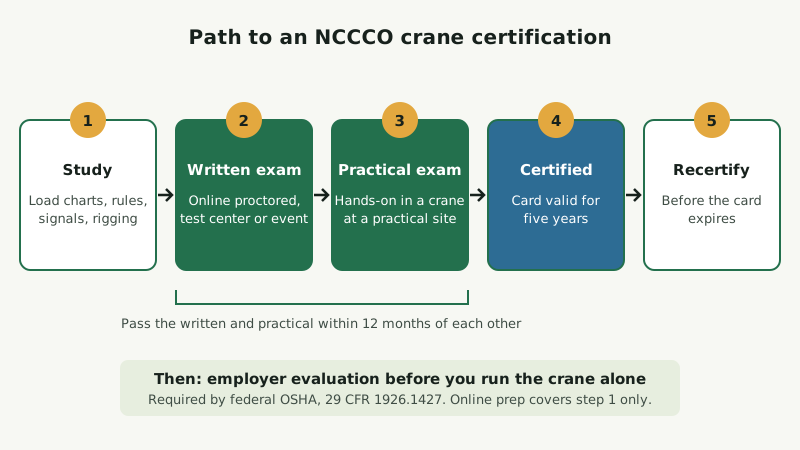
- Pick the designation that matches your machine, such as telescopic boom small (TSS) or large (TLL), lattice boom (LAT), tower, articulating or digger derrick, and study for its written exams.
- Take the written exams by Online Proctored Testing on your own computer with a webcam and microphone in a private room, at a test center, or at a scheduled testing event. Applications and scheduling go through the myCCO portal.
- Arrange the practical exam, which is always hands-on in a real crane at a practical test site. NCCCO lists sites and events; no online course can stand in for it.
- Pass the matching written and practical exams within 12 months of each other. The window starts with whichever exam you pass first.
- Once certified, the card runs for five years. Your employer still has to evaluate you on the equipment you will operate.
Staying current, and where online study helps
NCCCO recertification is normally done in the final 12 months before the card expires, which lets the new five-year term start from the old expiration date instead of the test date. Operators take written recertification exams, and an operator who can document at least 1,000 hours of crane-related experience during the certification period does not need to retake the practical. Letting the card lapse can mean starting the full process again, so put the expiration date on the calendar early.
Arkansas contractors, plant owners and general contractors set their own site requirements, and it is common for them to ask for an accredited card even where federal law would not demand one. Online prep handles the knowledge side of all this: load charts, Subpart CC content, rigging and signaling theory, and exam-style practice questions you can work through on any device, at any hour. It does not issue a certification, satisfy an employer's evaluation or replace seat time. See the mobile crane operator course, rigger level 1, signal person and mobile crane recertification, or use the enrollment form and an enrollment advisor will reply.
For the career side of the same questions, see certification versus licensing and the rest of our crane career guides.
Questions people ask
If I get NCCCO certified in Arkansas, do I also need something from the state?
No. Arkansas has no state crane license to add on top. Your employer still owes you a documented evaluation on the equipment you run, and individual sites can set extra rules.
Will an ADLL consultant report my company to OSHA?
The consultation program is confidential and kept separate from federal enforcement, and consultants do not write citations. You are expected to correct serious hazards they find within the agreed time.
Is a boom truck covered by the federal crane rule?
Usually yes, when it is used for construction and rated over 2,000 pounds. Boom trucks are hoisting equipment under Subpart CC; NCCCO certifies them under its telescopic boom small (TSS) designation. Its separate fixed-cab boom truck (BTF) exam was retired in 2021, and existing BTF holders recertify through TSS.
Does an operator-in-training need a certificate before touching the controls?
No, but the trainee may operate only under the conditions in 1926.1427, including continuous on-site monitoring by a trainer.
Who checks crane work done by a state agency or a city crew?
Federal OSHA does not cover state or local government employees in Arkansas, so those agencies set their own safety policies. Private contractors on public projects remain under federal OSHA.
Related courses
-
Mobile Crane Operator
Self-paced study for the NCCCO mobile crane Core and your LAT, TLL or TSS specialty, aimed at Arkansas operators on hydros, all-terrains and crawlers.
-
Rigger Level I
Self-paced study for the NCCCO Rigger Level I written test, covering slings, hitches, hardware checks and signals for crew members who rig everyday picks with a known load weight.
-
Signalperson
Study for the NCCCO Signalperson written test on any device, covering standard hand signals, voice and radio communication, crane behavior and the federal OSHA rules for directing a lift.
-
Crane Recertification
A focused refresher for Arkansas operators renewing an NCCCO mobile crane certification, covering the core and specialty written tests, the renewal timeline and the 1,000-hour practical waiver.
Start your Arkansas crane certification prep
Name the card you need (operator, rigger or signal person) and the part of Arkansas you work in. An enrollment advisor writes back with the matching course and what the exam steps look like from there.
- Self-paced lessons that open on any device, day or night
- Practice questions written in the style of NCCCO written tests
- Crew enrollment for Arkansas contractors and plants
Ask about enrollment
Short form. Your details are used only to reply to you.