NCCCO Signalperson · Federal OSHA 1926.1428
Signal Person Certification Prep for Arkansas Job Sites
An operator in the cab of a crane often cannot see where the load is going. On a tight downtown lot in Little Rock, over the side of a barge at a river terminal, or behind the walls of a steel building going up in Rogers, the signal person becomes the operator's eyes. One wrong or unclear signal can put a load into a wall, a power line or a person. NCCCO's Signalperson certification shows that you know the standard signals, understand how cranes behave and can keep a lift under control. Arkansas has no state signal person card, so on private jobs the federal OSHA rule is what sets the bar.
Topics in this course
- The standard hand signals for mobile, tower and overhead work
- Giving clear voice commands over a radio
- Situations where federal OSHA requires a signal person
- How booms deflect, loads swing and hooks two-block
- Watching for power lines, blind spots and people in the fall zone
- Who may give a stop or emergency stop, and when
- What to do when the operator does not respond as expected
- ASME B30 signal charts and the OSHA rules behind them
Where Arkansas lifts need someone signaling
Federal OSHA, the agency covering private construction in Arkansas, requires a signal person when the operator cannot see the point of operation or the load's path, or when either the operator or the person handling the load decides one is needed because of site conditions. That covers a big share of real work: picks over a roof parapet, loads lowered into a pit, steel set behind already-erected columns, or materials swung onto a barge deck below the dock edge.
Arkansas offers plenty of all of these. The public river ports at Fort Smith, Little Rock and Pine Bluff move barge freight on the McClellan-Kerr navigation system. Steel mills in Mississippi County run cranes all day. Northwest Arkansas keeps adding offices, hospitals and apartments, with Walmart's Bentonville Home Office campus opening in phases through 2025 as the most visible example.
The qualification standard, in short
Under 1926.1428 a signal person has to be qualified either by a third-party qualified evaluator or by the employer's own qualified evaluator. Either way, the person must know and understand the signals in use, be competent in applying them, have a basic grasp of crane operation and limits, including boom deflection and two-blocking, and pass an oral or written test plus a practical one.
Third-party qualification is portable: you can take it from one employer to the next. A qualification done by your own employer's evaluator only covers that employer. That portability is why many Arkansas contractors and staffing crews prefer an NCCCO card. The full picture of who regulates what in this state is in our requirements guide.
Inside the NCCCO exams
The written portion is 60 multiple-choice questions with an hour to finish. Hand signals carry the most weight, followed by basic crane operations, voice communication, situational awareness and safety standards. You can sit it through Online Proctored Testing, at a test center or at a testing event.
The practical has no time limit and most candidates finish in about 15 minutes. You are shown 30 scenarios and must give the right hand or voice signal for each one. Signals follow OSHA Subpart CC, with ASME B30 charts used where OSHA does not specify. Pass both, in either order within 12 months of each other, and the card lasts five years.
Renewal is unusual. Signalperson is the one NCCCO program where recertification uses the practical exam instead of a written test, taken in the final year before expiration.
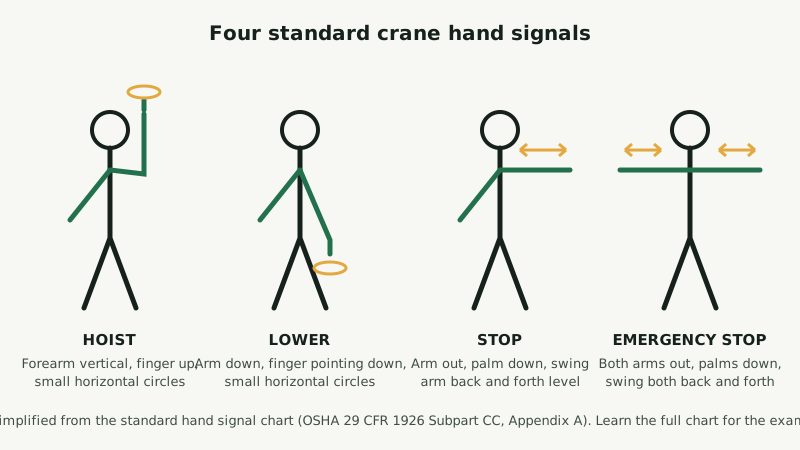
Signals in Arkansas weather and noise
Heat and humidity shorten attention in July and August, and that is when signals get lazy. Spring storm lines bring sudden wind shifts, rain that makes hand signals harder to read at a distance, and lightning that should stop a lift outright. Mills, ports and active job sites are loud, so radios and voice procedures matter as much as hand signals. A good signal person announces the direction, the distance and the stop in the same calm order every time.
Delta jobs add another layer. Soft ground and long, open sites put cranes farther from the load, so the signal person may be well out of easy sight of the cab and fully dependent on radio.
- Agree on radio channel and call words before the first pick
- Stay in the operator's view or keep constant voice contact
- Give one signal at a time and wait for the response
- Remember that anyone may call an emergency stop
Using the course
The lessons walk through each hand signal with a description of the motion and when it is used, then cover voice procedures, crane behavior and the federal rules. Practice questions mirror the style of the written test so you can see where you are weak before you schedule it. It all runs on a phone, any time of day.
Practice the actual motions out loud and in front of a coworker. The practical tests what you do, not just what you know.
Questions people ask
Does Arkansas license crane signal persons?
No. There is no state card. On private construction sites, federal OSHA 1926.1428 requires a qualified signal person, qualified either by a third-party evaluator such as NCCCO or by the employer's own evaluator.
Do I have to retake the written test to renew?
No. NCCCO Signalperson recertification uses the practical exam, which you can take up to a year before your card expires. If the card lapses, both exams are required again.
Is a radio command treated differently from a hand signal?
Both are covered. Voice signals have their own procedures: identify the crane, give the function, direction and distance, and keep the channel clear. Expect written test questions on both.
Should riggers also get signal person certification?
Many do, because on small crews the same person often rigs and signals. Pairing this course with Rigger Level I is a common path.
Crane Courses
-
Mobile Crane Operator
Self-paced study for the NCCCO mobile crane Core and your LAT, TLL or TSS specialty, aimed at Arkansas operators on hydros, all-terrains and crawlers.
-
Tower Crane Operator
Study for the single NCCCO tower crane written exam online, then test hands-on on a hammerhead, luffer or self-erector, as Bentonville and Little Rock projects keep adding cranes.
-
Articulating Crane Operator
Written exam prep for the three NCCCO articulating crane designations, for Arkansas drivers dropping building materials, running log loaders or handling scrap with a grapple.
Start your Arkansas crane certification prep
Name the card you need (operator, rigger or signal person) and the part of Arkansas you work in. An enrollment advisor writes back with the matching course and what the exam steps look like from there.
- Self-paced lessons that open on any device, day or night
- Practice questions written in the style of NCCCO written tests
- Crew enrollment for Arkansas contractors and plants
Ask about enrollment
Short form. Your details are used only to reply to you.