Core + LAT, TLL or TSS · Self-paced written exam prep
Prepare for NCCCO Mobile Crane Certification from Anywhere in Arkansas
Steel mill expansions in Mississippi County, river terminals along the Arkansas River and a steady stream of new buildings in Benton and Washington counties all depend on mobile cranes. If you want to run one on construction work in Arkansas, the state will not hand you a license, because it does not issue one. What applies is federal OSHA's crane standard, which calls for certification through an accredited testing organization and an evaluation by your employer. The NCCCO Mobile Crane Operator program is the credential most Arkansas contractors ask for, and this course gets you ready for its written exams on your own schedule.
Topics in this course
- Judging soil support, mat and crib sizing before the outriggers go down
- Leveling, configuration checks and the walkaround before the first pick
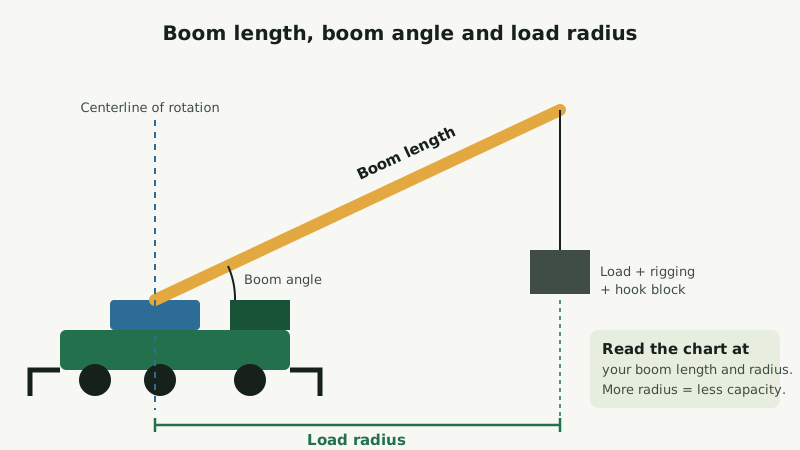
- Working a load chart: capacity at radius, deductions for rigging and stowed attachments
- Boom angle, length and operating quadrant questions the specialty exams like to ask
- Encroachment zones and the steps Subpart CC requires near energized lines
- How wind, rain-soaked ground and heat change what the crane can safely do
- Hand and voice signals, and when to stop for an unclear one
- Rated capacity limiters and other operational aids, and what to do if one is out
- ASME B30.5 and OSHA 1926 Subpart CC points that show up on the Core
Arkansas jobs that keep mobile cranes busy
Mississippi County has become one of the largest steelmaking areas in the country. U.S. Steel's Big River Steel campus at Osceola and its second mill there, announced in 2022 with two electric arc furnaces, drew big crawler and all-terrain cranes for years of construction and keep drawing them for maintenance outages.
Along the McClellan-Kerr Arkansas River Navigation System, which opened in 1971 and links the Mississippi River to the Tulsa area, port terminals such as the Port of Little Rock handle heavy cargo that often moves by crane. In Northwest Arkansas, population growth in Bentonville, Rogers, Fayetteville and Springdale has kept hydros on schools, apartments, medical buildings and warehouses.
The type of work you chase decides your specialty. Truss setting and rooftop units usually point to TLL or TSS. Industrial plant work and long-boom picks often point to LAT. Plenty of operators end up holding two.
Two layers of written testing, then the seat
Every candidate sits the Core exam, which NCCCO lists at 90 multiple-choice questions in 90 minutes. It covers what is shared across every mobile crane: the site, setup, operations, technical knowledge and load charts. You then add at least one specialty written exam, each listed at 26 questions in 60 minutes, built around one crane family's charts and quirks.
LAT is for lattice boom cranes, crawler or truck mounted, and replaced the old LBC and LBT codes. TLL is for telescopic cranes where the cab swings with the upper, which covers most rough-terrain and all-terrain hydros. TSS is for telescopic cranes run from a fixed cab, such as many boom trucks; restricted sub-categories like the service truck crane (STC) sit under it.
After the written side comes a hands-on practical exam on the crane type you want on your card, given at an accredited practical site. NCCCO expects it within 12 months of passing the written. Written exams can be taken by Online Proctored Testing, at a test center or at a scheduled testing event.
Ground and weather questions with an Arkansas accent
The Core spends a lot of time on whether the ground can carry the crane. In the Delta, saturated alluvial soils and fresh fill can lose strength after a week of rain, and a mat that looked generous on dry ground may not be enough. In the Ozarks and Ouachitas, the problem flips: rock ledges, slopes and narrow benches make level setup the hard part.
Spring brings severe thunderstorms and tornado watches, so the exam's rules on wind and on the competent person's duty to adjust or stop a lift are worth knowing cold. Summer humidity and heat wear on hydraulics and operators alike.
How the course fits into your path to a card
You study the Core domains first, then switch to the material for the specialty you picked, working practice questions on load charts as you go. It runs on any device, any hour.
Seat time and the practical are on you and the certifier; no website can test your hands on the controls. And once certified, OSHA 1926.1427 still makes your employer evaluate you on the crane you will run before you work solo.
- Choose LAT, TLL or TSS based on the machine you run
- Work through the Core and specialty lessons online
- Book and pass the written exams with NCCCO
- Pass the matching practical inside the 12-month window
- Finish your employer's evaluation on the actual crane
Questions people ask
Is there an Arkansas crane operator license I need on top of NCCCO?
No. Arkansas does not issue a state crane operator license, and the state has no OSHA State Plan, so private-sector crane work falls under federal OSHA. Federal rules call for accredited certification plus an employer evaluation. Our Arkansas requirements guide walks through it.
If I pass TLL now, can I add LAT later without redoing the Core?
Yes. The Core stays on your record; adding a designation means passing that specialty written exam and its practical. NCCCO generally ties an added specialty's expiration to your existing certification dates.
My crane is a boom truck. Which specialty fits?
Look at the controls. A boom truck run from a fixed station generally lines up with TSS, while a telescopic crane whose cab rotates with the boom lines up with TLL. Confirm with the machine before registering.
When does my certification run out?
Mobile crane certification lasts five years. Operators who can document at least 1,000 hours of crane-related experience during that period can generally skip the recertification practical. See our recertification course.
Crane Courses
-
Tower Crane Operator
Study for the single NCCCO tower crane written exam online, then test hands-on on a hammerhead, luffer or self-erector, as Bentonville and Little Rock projects keep adding cranes.
-
Articulating Crane Operator
Written exam prep for the three NCCCO articulating crane designations, for Arkansas drivers dropping building materials, running log loaders or handling scrap with a grapple.
-
Rigger Level I
Self-paced study for the NCCCO Rigger Level I written test, covering slings, hitches, hardware checks and signals for crew members who rig everyday picks with a known load weight.
Start your Arkansas crane certification prep
Name the card you need (operator, rigger or signal person) and the part of Arkansas you work in. An enrollment advisor writes back with the matching course and what the exam steps look like from there.
- Self-paced lessons that open on any device, day or night
- Practice questions written in the style of NCCCO written tests
- Crew enrollment for Arkansas contractors and plants
Ask about enrollment
Short form. Your details are used only to reply to you.