Entry-level rigging · NCCCO Level I
Rigger Level I Prep for Arkansas Ground Crews
Ask any Arkansas crane operator who they trust most on a lift and the answer is usually the person who rigged it. Coils coming off barges at the river ports, beams going up on a Bentonville office building and pump housings coming out of a plant for overhaul all start with someone on the ground choosing the right sling and hitch. NCCCO's Rigger Level I card documents that a person can handle routine rigging when the weight and balance point of the load are already known. Arkansas has no state crane or rigging license, so this nationally accredited credential is the most common way workers here show they have the basics down.
Topics in this course
- Choosing between wire rope, alloy chain, web and round slings
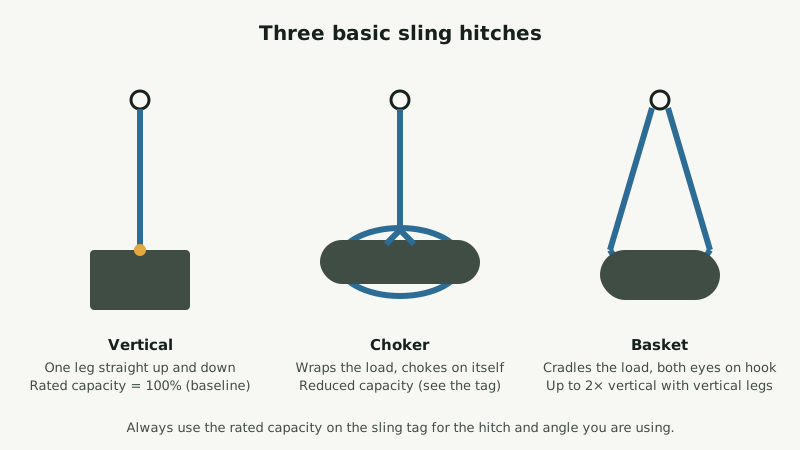
- Vertical, choker and basket hitches and what each does to capacity
- Why flatter sling angles raise leg tension
- Reading tags and markings on shackles, hooks and eyebolts
- Pre-use checks and the damage that pulls gear out of service
- Common knots tested on the practical
- Keeping out of the fall zone and using tag lines
- Standard hand signals a rigger is expected to know
- When federal OSHA calls for a qualified rigger
What Level I rigging looks like across Arkansas
Mississippi County produces more steel than any other county in the country, with Nucor's plants near Blytheville and the Big River Steel complex at Osceola. Mills like these run constant rigging work: rolls, motors, ladle parts and bundles of product moved by overhead and mobile cranes. Much of it is repetitive, with known weights stamped or listed, which is exactly the kind of lift Level I is built around.
On the McClellan-Kerr Arkansas River system, the public ports at Fort Smith, Little Rock and Pine Bluff handle barge freight, and steel in coil, wire rod and bar form is the main cargo at Fort Smith. Each transfer between barge, truck and rail involves slings or below-the-hook gear. Up in Benton and Washington counties, steady commercial building, including Walmart's new Home Office campus that began a phased opening in January 2025, keeps ironworkers and laborers hooking up steel and precast.
Two exams, one card
NCCCO splits Level I into a written test and a hands-on practical. The written portion gives you an hour for 60 multiple-choice items on rigging gear, hitches, angles, inspection and signals. It can be taken through Online Proctored Testing, at a test center or at a scheduled testing event.
The practical is a set of four tasks that build in difficulty: inspecting rigging before use, making hitches, making connections, and tying basic knots, all inside a 60-minute limit. You watch NCCCO's candidate video shortly before the test so you know what the examiner will ask. Pass either exam first; the clock then gives you 12 months to pass the other one. Once both are done, the certification runs five years.
- Minimum age of 18
- Agree to NCCCO's Code of Ethics and substance abuse policy
- Pass the Level I written test
- Pass the Level I practical with an accredited examiner
Federal rules, not state rules
Arkansas runs no OSHA State Plan, so private construction sites here answer to federal OSHA through its Little Rock Area Office. Under 29 CFR 1926.1425, a qualified rigger must do the rigging whenever workers in the fall zone are hooking, unhooking or guiding a load, or making the first connection to a structure. Section 1926.1404 adds the same requirement during crane assembly and disassembly.
"Qualified" is the employer's call, based on credentials or proven knowledge and experience. A certification is not mandatory, but it gives the employer an outside record to point to, and plenty of owners and general contractors around Little Rock and Northwest Arkansas list certified riggers in their site rules. The state's own role is advisory: the Arkansas Department of Labor and Licensing offers free, confidential safety consultation to private employers, separate from enforcement. Our requirements guide walks through the details.
Humidity, storms and the gear you inspect
Arkansas summers are hot and humid, and spring is the main severe weather season, with thunderstorms, hail and tornadoes most likely from March through May. Wet synthetic slings, rust on chain and wire rope stored outdoors, and mud packed into hardware all show up on pre-use checks here. Sudden gust fronts ahead of a storm line make sheet goods and long steel catch wind, so tag lines and a clear fall zone are not optional.
Level I does not teach weather forecasting, but it does teach you what damage to look for and when a sling has to come out of service. That inspection habit is one of the four practical tasks, and it is the part experienced crews say pays off most on the job.
How the online course is set up
Lessons are short and work on a phone, tablet or laptop, so you can study on a break at the mill or in the truck before shift. Each topic ends with practice questions in the same style as the written test, and sling-angle problems get their own drill set since they trip up a lot of candidates. You study any hour, at your own pace.
Knots, hitches and gear inspection still have to be shown with your hands in front of an examiner. Spend time with real slings and shackles on the job before you book the practical, and use the course to lock in the knowledge side.
Questions people ask
Does Arkansas require a state rigging card?
No. Arkansas does not license riggers or crane operators. Federal OSHA's crane standard requires qualified riggers for certain work, and employers decide who is qualified. Many use NCCCO certification as their evidence.
How long does the Level I practical take?
NCCCO sets a 60-minute limit for the four practical tasks. If time runs out, you receive credit only for the tasks or sub-tasks finished.
Is Level I enough for every lift on my site?
It fits routine picks where the weight and center of gravity are known. Estimating weights, finding the balance point of odd-shaped loads and rigging multi-point lifts belong to Rigger Level II.
What happens when my rigger card nears five years?
NCCCO rigger recertification is done with the written exam, inside the 12 months before your card expires. There is no grace period, so a lapsed card means retaking both the written and practical.
Crane Courses
-
Mobile Crane Operator
Self-paced study for the NCCCO mobile crane Core and your LAT, TLL or TSS specialty, aimed at Arkansas operators on hydros, all-terrains and crawlers.
-
Tower Crane Operator
Study for the single NCCCO tower crane written exam online, then test hands-on on a hammerhead, luffer or self-erector, as Bentonville and Little Rock projects keep adding cranes.
-
Articulating Crane Operator
Written exam prep for the three NCCCO articulating crane designations, for Arkansas drivers dropping building materials, running log loaders or handling scrap with a grapple.
Start your Arkansas crane certification prep
Name the card you need (operator, rigger or signal person) and the part of Arkansas you work in. An enrollment advisor writes back with the matching course and what the exam steps look like from there.
- Self-paced lessons that open on any device, day or night
- Practice questions written in the style of NCCCO written tests
- Crew enrollment for Arkansas contractors and plants
Ask about enrollment
Short form. Your details are used only to reply to you.