NCCCO ABC · ABL · ABW · Online written exam prep
Knuckleboom Certification Prep for Arkansas Drivers and Loader Operators
Knuckleboom trucks show up all over Arkansas. They drop shingles and trusses in fast-growing Benton County towns like Centerton, which nearly doubled its population between 2010 and 2020. They swing logs onto trailers bound for big forest-products mills in Crossett and Ashdown, and grapple loaders sort scrap for the electric arc furnaces that drive Mississippi County's steel output. Arkansas does not license crane operators, and federal OSHA's rules decide when this work needs certification. When it does, NCCCO's articulating crane program is the usual answer, and this course prepares you for its written exams.
Topics in this course
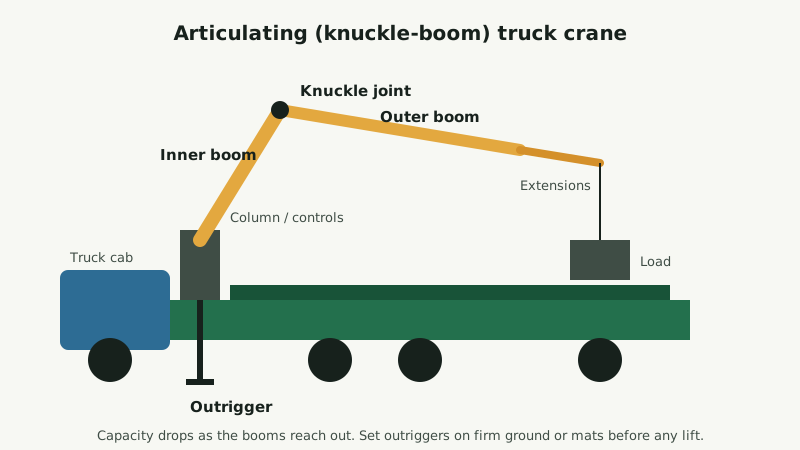
- How the inner boom, outer boom, extensions and jib share the work
- Placing stabilizers on curbs, gravel drives and unfinished lots
- Capacity charts that shift as each section folds or extends
- Running from the seat versus a radio remote
- Forks, clamshells, grapples and rotators, and the weight they take off the chart
- Overload protection and why a bypassed system is a red flag
- The OSHA line between material delivery and crane work
- Overhead service drops and line clearance in neighborhoods
- Winch, hook block and basic rigging for ABW candidates
Three designations, three different machines
NCCCO divides articulating cranes by how they are used. ABC (Articulating Boom Crane) is the standard knuckleboom carrying material on forks, clamps or a hook. NCCCO lists its written exam at 65 questions. ABL (Articulating Boom Loader) covers loader-style machines, typically with a grapple, the kind that work logs, pipe and scrap; its written exam is listed at 50 questions. ABW (Articulating Boom Crane with Winch) is for cranes rigged with a winch and hook block, with a written exam listed at 75 questions.
Each written exam allows 90 minutes, and NCCCO provides an on-screen calculator. You can take the written or the practical first. Pass the written for the designation you want plus a matching practical and you are certified for five years.
For recertification, the written exam is the same one used for initial certification. Operators who can attest to at least 1,000 hours of crane-related experience during their certification period generally do not need to retake the practical.
When a delivery stops being a delivery
Federal OSHA, which covers private employers in Arkansas because the state has no State Plan, excludes some knuckleboom work from its crane standard at 1926.1400(c)(17). Moving materials from the truck bed to the ground, without arranging them in a sequence for hoisting, sits outside Subpart CC. Setting sheet goods or packaged materials onto a structure with forks or a cradle can also be excluded, but only with a working automatic overload prevention device and only under the conditions written into the rule.
Holding a truss while carpenters nail it off, staging steel in erection order, or rigging a load to the hook moves the job into crane work. At that point 1926.1427 certification applies. Since one truck can do both in the same afternoon, many Arkansas suppliers certify every driver instead of sorting it out load by load.
Arkansas conditions the written exam will test you on
New subdivisions in Northwest Arkansas mean freshly cut lots, trenches backfilled last week and driveways not yet poured. In the timber country of south Arkansas, a log loader may set up on a skid road softened by rain. Either way, stabilizer placement and ground support are core exam topics, and pads under the feet are cheap compared to a tipped truck.
Older neighborhoods in Little Rock, Fort Smith and Hot Springs put service drops and distribution lines close to where the truck has to park. Expect questions on approach distances and on what a spotter does. Thunderstorms, summer humidity and the occasional winter ice storm add footing and visibility problems that a careful operator plans around.
Study layout and what stays hands-on
The course moves from machine geometry to stabilizers, capacity charts, attachments, inspection, operation and regulations. ABL candidates get grapple and loader material; ABW candidates get extra lessons on winch lines and hook blocks. Chart reading gets the most practice, since every fold and extension changes what the crane can lift.
The written exams are only half of certification. The practical is a hands-on test given by an accredited examiner, and your employer still has to evaluate you on the truck you will operate.
Questions people ask
I run a grapple loader on a log truck. Which exam do I take?
A loader-style articulating machine with a grapple generally falls under ABL. If you also lift with forks or a hook on construction sites, ABC may suit you better, and some operators hold both.
Does my TSS boom truck certification cover a knuckleboom?
No. Articulating cranes have their own NCCCO program, separate from telescopic boom trucks. Your certification needs to match the machine.
Do Arkansas suppliers have to certify drivers who only drop on the ground?
Ground-only drops that are not arranged for hoisting fall under the 1926.1400(c)(17) exclusion. Employers set their own policies, though, and many require certification anyway. The Arkansas requirements guide explains the federal rules that apply.
Can I add ABW after earning ABC?
Yes. Each added designation needs its own written exam and a matching practical, and an added designation generally expires with your original certification.
Crane Courses
-
Mobile Crane Operator
Self-paced study for the NCCCO mobile crane Core and your LAT, TLL or TSS specialty, aimed at Arkansas operators on hydros, all-terrains and crawlers.
-
Tower Crane Operator
Study for the single NCCCO tower crane written exam online, then test hands-on on a hammerhead, luffer or self-erector, as Bentonville and Little Rock projects keep adding cranes.
-
Rigger Level I
Self-paced study for the NCCCO Rigger Level I written test, covering slings, hitches, hardware checks and signals for crew members who rig everyday picks with a known load weight.
Start your Arkansas crane certification prep
Name the card you need (operator, rigger or signal person) and the part of Arkansas you work in. An enrollment advisor writes back with the matching course and what the exam steps look like from there.
- Self-paced lessons that open on any device, day or night
- Practice questions written in the style of NCCCO written tests
- Crew enrollment for Arkansas contractors and plants
Ask about enrollment
Short form. Your details are used only to reply to you.