NCCCO DDO · Utility and storm work
Digger Derrick Certification Prep for Arkansas Line Crews
After the March 2025 tornadoes, Craighead Electric Cooperative in northeast Arkansas counted nearly 70 broken poles, 43 of them needing off-road equipment to replace, while North Arkansas Electric Cooperative crews worked to replace more than 400 damaged poles. After an August storm, Arkansas Valley Electric reported 136 broken poles identified across its system. Every one of those poles goes back in with a digger derrick. Whether the operator needs crane certification depends on the task, and NCCCO's Digger Derrick Operator credential covers the cases where it does. This course prepares you for its written exam.
Topics in this course
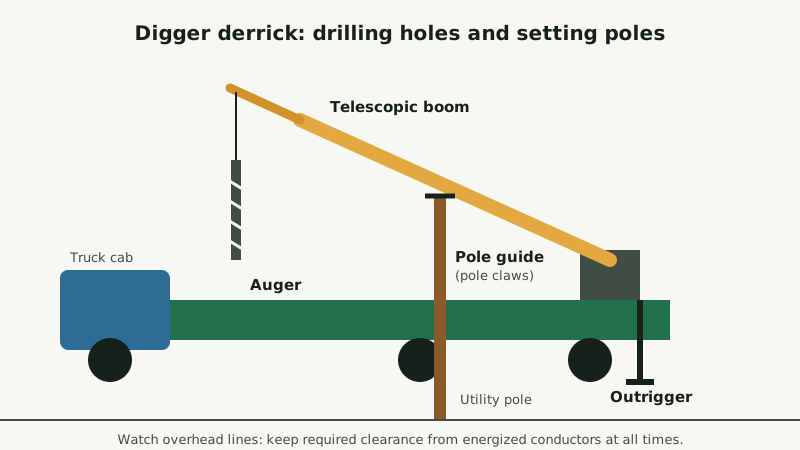
- Parts of a digger derrick: auger, pole claw, boom sections, winch and outriggers
- Reading the ground before you dig: fill, wet bottomland and rock
- Daily checks of the boom, hydraulics, winch line and any insulated sections
- Capacity charts for poles and for material lifts
- Drilling holes, setting poles and pulling broken ones
- Minimum approach distances near energized conductors
- Exactly which tasks the 1926.1400(c)(4) exclusion covers
- Ground crew communication and hand signals
Pole work, other work, and the certification question
OSHA's crane standard carves out a specific job at 1926.1400(c)(4). A digger derrick is outside Subpart CC when it augers holes for poles carrying electric or telecommunication lines, places or removes those poles, or handles materials being installed on or removed from them, or does other work covered by Subpart V. The catch is that the employer must comply fully with 1910.269 for power work, or 1910.268 for telecom.
Step off the pole and the picture changes. OSHA's own example: setting the pole is excluded, but setting a pad-mount transformer on the ground is not. Erecting signs, lights or other non-utility structures with a digger derrick is also crane work. In those cases the operator needs 1926.1427 certification.
In Arkansas the enforcing agency is federal OSHA, because the state runs no State Plan for private employers, and the state issues no crane license of its own. Public utilities owned by cities or other government bodies are outside federal OSHA coverage, though many follow the same practices.
Storms, mutual aid and mixed workloads
Arkansas co-ops lean on each other after big storms. In the March 2025 event, Craighead Electric brought in mutual aid from Arkansas Electric Cooperative and others, and Ozarks Electric sent crew members to help North Arkansas Electric. Spring tornadoes, summer straight-line winds and winter ice storms all bring pole replacement in rough conditions.
Restoration days are long and the work list is not always pure pole setting. A crew might also lift a transformer onto a pad, unload materials at a staging yard or help a contractor on a commercial site. That is why many employers certify digger derrick operators even though most of their work falls under the exclusion.
What NCCCO tests
The written exam has five domains with approximate weights published by NCCCO: Site about 11 percent, Pre-Operation about 17 percent, Operation about 36 percent, Technical Knowledge about 19 percent, and Manufacturers' Load Charts about 17 percent. Site questions focus on whether the ground can carry the expected loads and what might be hidden below the surface.
The practical asks you to show you can control a load, dig a hole and place a pole, at a practical site approved in advance by NCCCO. The two exams can be taken in either order; after passing the first, you have 12 months to pass the second. Certification renews every five years.
Arkansas ground, and how the course handles it
Augering in the Delta can mean wet, soft alluvial soil where outrigger pads sink and holes cave. In the Ozarks and Ouachitas, rock close to the surface can stop an auger cold. Off-road access after a tornado may mean setting up on a pasture or a washed-out right-of-way. The site and load chart lessons are built around those decisions.
Lessons follow the five exam domains, with practice questions on chart reading, energized-line clearances and the edges of the exclusion. Study from home, the shop or a motel room during storm duty. Practical testing stays in person, and your employer still evaluates you on the derrick you will run.
Questions people ask
We only set and pull distribution poles. Does our crew need DDO certification?
Pole work for electric or telecom lines is excluded from Subpart CC under 1926.1400(c)(4) as long as the employer complies with 1910.269 or 1910.268. Lifting other loads on construction work can bring crane rules back in, which is why many employers certify anyway.
Does a digger derrick certification let me run a mobile crane or a bucket truck?
No. DDO covers digger derricks only. Mobile cranes have their own NCCCO program, and aerial lifts fall under different rules.
Who enforces these rules on Arkansas utility jobs?
For private employers, including electric cooperatives and contractors, federal OSHA through its Little Rock Area Office. See the Arkansas requirements guide for details.
What does the practical exam involve?
You demonstrate controlling a load, digging a hole and placing a pole on a digger derrick, at an NCCCO-approved practical site with an accredited examiner.
Crane Courses
-
Mobile Crane Operator
Self-paced study for the NCCCO mobile crane Core and your LAT, TLL or TSS specialty, aimed at Arkansas operators on hydros, all-terrains and crawlers.
-
Tower Crane Operator
Study for the single NCCCO tower crane written exam online, then test hands-on on a hammerhead, luffer or self-erector, as Bentonville and Little Rock projects keep adding cranes.
-
Articulating Crane Operator
Written exam prep for the three NCCCO articulating crane designations, for Arkansas drivers dropping building materials, running log loaders or handling scrap with a grapple.
Start your Arkansas crane certification prep
Name the card you need (operator, rigger or signal person) and the part of Arkansas you work in. An enrollment advisor writes back with the matching course and what the exam steps look like from there.
- Self-paced lessons that open on any device, day or night
- Practice questions written in the style of NCCCO written tests
- Crew enrollment for Arkansas contractors and plants
Ask about enrollment
Short form. Your details are used only to reply to you.