NCCCO TSS-STC · For mechanics' trucks
Service Truck Crane Certification for Arkansas Field Mechanics
When a dozer breaks down on a Northwest Arkansas site or a gearbox fails at a mill in Mississippi County, the fix usually rides in on a mechanic's truck with a small telescopic crane behind the cab. These cranes look minor next to a crawler, but on construction work they are still doing lifting covered by OSHA's crane standard. Arkansas has no state crane license and no OSHA State Plan, so federal rules decide what certification you need. NCCCO built a restricted credential for exactly this machine, and this course gets you ready for its written exam.
Topics in this course
- How NCCCO decides whether a crane counts as a service truck crane
- Setting outriggers on a service body, including on uneven plant and farm ground
- Capacity charts for short telescopic booms
- Operating by radio remote or pendant from beside the truck
- Lifting gearboxes, cylinders, pumps, motors and tires without overloading
- Pre-use inspection of the hook, wire rope, hydraulics and overload device
- Overhead line hazards on rural roads and inside industrial yards
- Slinging basics so the load comes up balanced
Where Arkansas service trucks earn their keep
Heavy industry gives Arkansas field mechanics plenty of work. The Osceola steel campus, where U.S. Steel added a second mill with two electric arc furnaces to the Big River Steel site, and Nucor's Hickman operations run mobile equipment that needs constant service. Large forest-products complexes, including Georgia-Pacific's at Crossett and Domtar's mill at Ashdown, keep log handlers and yard equipment running around the clock.
In Springdale, Tyson's operations include processing plants, a hatchery, a feed mill and a truck terminal, all with fleets and fixed equipment that sometimes need a lift. River terminals on the Arkansas River add cranes, conveyors and handlers of their own. And across the Delta, irrigation pumps and farm machinery break down far from any shop.
Most of that service work happens on industrial or agricultural property. But the same truck may get sent to a construction job the next morning, where crane rules apply in full.
A narrower card than full TSS
NCCCO introduced the program in 2013 as a restricted form of its Telescopic Boom, Fixed Cab (TSS) mobile crane certification. The designation is TSS-STC, and it covers service truck cranes only. NCCCO's definition looks at telescopic cranes whose base and mast are not part of the outrigger or stabilizer system, which describes most mechanics' trucks.
The restriction works in one direction. A full TSS holder does not need STC to run a service truck crane, but an STC holder cannot use that card to run a boom truck or another fixed-cab crane. A shop whose mechanics only ever operate service bodies can keep things focused with STC; one that also moves parts with a yard boom truck may prefer to certify to full TSS.
How the two exams work
You pass one written exam and one practical, in either order, within twelve months of each other. The practical is based on the TSS practical but adjusted for smaller cranes and for remote or pendant controls, so you can test the way you actually operate.
Mechanics usually know hydraulics better than anyone on site. What tends to cost points is the formal material: reading capacity charts, power line rules, signals and the regulations. The online lessons spend most of their time there.
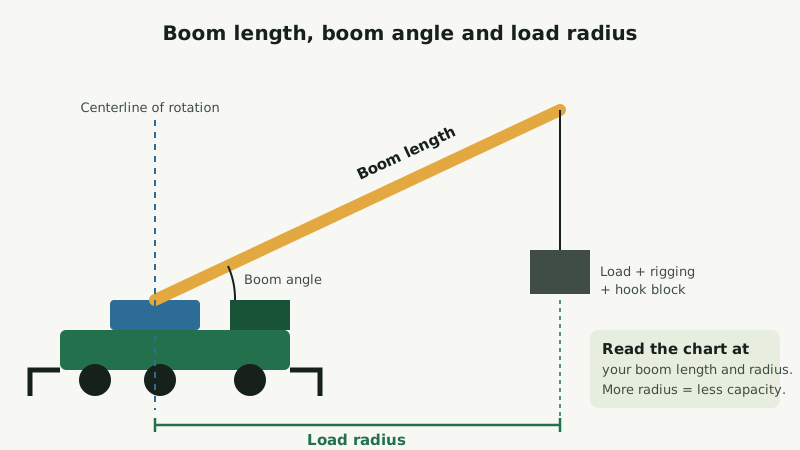
- Chart problems sized for compact telescopic cranes
- Power line and signal rules in plain language
- Inspection points tied to the exam outline
- Study on a phone between service calls
Rules, mines and your employer's part
On construction sites, Subpart CC requires operators of covered cranes to be certified through an accredited body, and 1926.1427 makes the employer evaluate each operator on the equipment and document it. Cranes with a maximum rated capacity of 2,000 pounds or less are handled under a separate section, 1926.1441, with its own training rules.
Actual mines and quarries are under MSHA rather than OSHA's construction crane standard. Mine operators often set their own expectations for anyone running a crane on their property, so ask before you show up. The written exam prep here supports the knowledge side; the practical is always taken in person with an accredited examiner.
Questions people ask
Is STC enough, or should I go straight for TSS?
If the only crane you operate is on a service truck, STC was designed for you. If you expect to run boom trucks or other fixed-cab cranes, full TSS covers more equipment. Our mobile crane course covers TSS.
Does Arkansas require anything beyond the federal rules for service truck cranes?
We did not find any Arkansas state or city crane license. Private employers fall under federal OSHA, and the requirements guide covers what that means for operators.
Can I use the remote on the practical?
Yes. NCCCO modified the STC practical to accommodate the remote and pendant controls common on service truck cranes.
Crane Courses
-
Mobile Crane Operator
Self-paced study for the NCCCO mobile crane Core and your LAT, TLL or TSS specialty, aimed at Arkansas operators on hydros, all-terrains and crawlers.
-
Tower Crane Operator
Study for the single NCCCO tower crane written exam online, then test hands-on on a hammerhead, luffer or self-erector, as Bentonville and Little Rock projects keep adding cranes.
-
Articulating Crane Operator
Written exam prep for the three NCCCO articulating crane designations, for Arkansas drivers dropping building materials, running log loaders or handling scrap with a grapple.
Start your Arkansas crane certification prep
Name the card you need (operator, rigger or signal person) and the part of Arkansas you work in. An enrollment advisor writes back with the matching course and what the exam steps look like from there.
- Self-paced lessons that open on any device, day or night
- Practice questions written in the style of NCCCO written tests
- Crew enrollment for Arkansas contractors and plants
Ask about enrollment
Short form. Your details are used only to reply to you.