Exam guide · Core + specialty · Load charts
The NCCCO Written Exams: Format, Content and How to Prepare
For most candidates, the written exams are where certification is won or lost on paper before anyone climbs into a test crane. This guide focuses on the mobile crane program because that is what most Arkansas candidates take, though the other NCCCO programs follow a similar pattern. Figures here come from NCCCO's own FAQ pages and candidate handbooks; NCCCO revises them from time to time, so open the current handbook for your crane type before test day and treat it as the final word.
How the mobile crane written test is built
The written side has two layers. Every mobile crane candidate takes the core exam, which covers knowledge common to all mobile cranes. NCCCO's written exam FAQ lists it at 90 multiple-choice questions with 90 minutes allowed. On top of that you take one or more specialty exams, each tied to a crane type: lattice boom (LAT), telescopic boom large (TLL) or telescopic boom small (TSS). Each specialty is listed at 26 questions in 60 minutes, and NCCCO's overview allows up to three specialties. Which one you need depends on your machine; the mobile crane operator course and service truck crane course are organized around those specialties.
To be certified you need the core plus at least one specialty, along with the matching practical. Older handbooks split lattice boom into separate crawler and truck exams; current material combines them into LAT. One of NCCCO's overview pages gives the core as 95 questions rather than 90, so confirm the count in the handbook that applies on your test date.
The specialty exams lean hard on load charts, and NCCCO's handbook has marked them as calculator-permitted while the core is not. How you calculate depends on where you test, covered below.
What the core exam covers
NCCCO's published outline groups the core exam into four domains. The approximate weights have shifted between the outline page and the newest handbook, but the four headings have stayed put.
- Site: ground conditions and stability, cribbing and mats, power line hazards and sizing up the work area before setup
- Operations: inspections, leveling, the operator's authority to stop a lift, and securing the crane when it is left unattended
- Technical knowledge: the governing standards, including ASME B30.5 and OSHA's Subpart CC, plus wire rope criteria and electrical hazards
- Load charts: chart terminology, range and work-area diagrams, and working out radius, gross capacity and net capacity
Load charts are the make-or-break topic
Candidates who come from the seat often know the machine cold and still stumble on the chart questions. The arithmetic is not hard; the discipline is. You have to read the right chart for the configuration given, find the correct radius, apply the right notes, and subtract every deduction (hook block, headache ball, rigging, stowed or erected jib) to get from gross to net capacity.
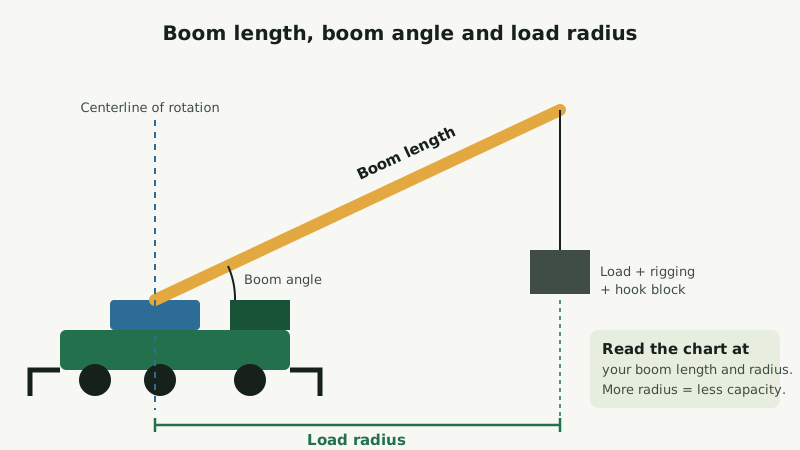
The diagram below shows the three quantities that drive almost every chart question: boom length, boom angle and load radius. Radius is measured horizontally from the center of rotation to the center of the load, and it grows as the boom comes down. Practicing with real manufacturer charts, not simplified tables, is the closest thing to a shortcut there is.
Online proctored, test center or testing event
NCCCO offers three ways to sit the written exams, and the content is the same whichever you pick. Whichever you choose, federal OSHA's operator rule, explained in the Arkansas requirements guide, is what makes the result count on a job site.
- Online Proctored Testing (OPT). You test on your own computer through a secure browser while a remote proctor watches. The room must be private with the door shut, quiet and well lit, with a hard work surface. You will show the proctor the walls and desk on camera at check-in and present a government photo ID. Physical scratch paper and calculators are not allowed; an on-screen whiteboard and tools take their place, or a dry-erase board no larger than 8.5 by 11 inches.
- Test center. You sit the exam at a testing center on a scheduled appointment, a good choice if your home internet in the Ozarks or Delta is unreliable.
- Testing event. Employers, unions and training providers sometimes host written exams for a group, often paired with a practical exam on the same trip.
Applying, scheduling and the 12-month clock
Applications run through NCCCO's myCCO portal. For online testing, NCCCO asks that the application go in at least two business days before you want to test; once approved you get a scheduling authorization and have six months from the application date to take the exam. Appointments can be moved or canceled at no charge until 30 minutes before the start, and a free demo exam lets you check your equipment ahead of time.
The bigger deadline is the one linking your exams. Pass the written and you have 12 months to pass the matching practical, or the other way around if you test practical first. Plan the practical before you start the written so the clock does not run out on you.
If you fail an exam
Failing one exam does not erase the others you passed. Under NCCCO's retake policy, you wait at least four weeks before taking the same written exam again unless an alternate form of that exam exists. For mobile crane specialties, the handbook allows a quicker retest by choosing a different load chart than the one you were first tested on. The waiting period applies to written exams only; practical retakes are not affected. Each retest needs a new application and fee.
Use the four weeks. Your score report shows where you were weak, and chart work in particular improves fast with deliberate practice. If you are still deciding whether the trade is for you, how to become a crane operator in Arkansas shows the bigger picture, and the enrollment form reaches an enrollment advisor.
A study plan that fits a working schedule
Most Arkansas candidates study around 10-hour days, so short regular sessions beat weekend cramming.
- Read the candidate handbook and the exam outline first, so you know what is actually tested
- Learn Subpart CC and ASME B30.5 topics in plain language: power line clearances, ground conditions, inspections, signals
- Work load chart problems several times a week, writing out every deduction until it becomes habit
- Use exam-style practice questions to find weak spots, then go back to the material rather than memorizing answers
- Take the online demo if you plan to test from home, and test in the same room you will use
- Book the practical early; see our practical exam guide
Questions people ask
Can I take the core and a specialty on the same day?
You can schedule them together, and many candidates do. Each exam keeps its own question count and time limit, so pace yourself for a long sitting.
Can I bring my own calculator?
Not for online proctored testing, where an on-screen calculator replaces it. For a test center or event, follow the calculator rules in the current candidate handbook, which has allowed calculators on the specialty exams but not the core.
Is the written exam the same online and at a test center?
The content and time limits are the same. Only the setting and the rules about what you may have at your desk differ.
Will online prep alone get me certified?
No. Prep helps with the written exams, but you also need to pass a hands-on practical exam in a real crane and be evaluated by your employer.
Related courses
-
Mobile Crane Operator
Self-paced study for the NCCCO mobile crane Core and your LAT, TLL or TSS specialty, aimed at Arkansas operators on hydros, all-terrains and crawlers.
-
Service Truck Crane Operator
Written exam prep for the restricted NCCCO Service Truck Crane credential, aimed at Arkansas mechanics who lift components with the crane on their service body.
-
Crane Recertification
A focused refresher for Arkansas operators renewing an NCCCO mobile crane certification, covering the core and specialty written tests, the renewal timeline and the 1,000-hour practical waiver.
-
Tower Crane Operator
Study for the single NCCCO tower crane written exam online, then test hands-on on a hammerhead, luffer or self-erector, as Bentonville and Little Rock projects keep adding cranes.
Start your Arkansas crane certification prep
Name the card you need (operator, rigger or signal person) and the part of Arkansas you work in. An enrollment advisor writes back with the matching course and what the exam steps look like from there.
- Self-paced lessons that open on any device, day or night
- Practice questions written in the style of NCCCO written tests
- Crew enrollment for Arkansas contractors and plants
Ask about enrollment
Short form. Your details are used only to reply to you.