Career guide · Entry path · NCCCO
How to Become a Crane Operator in Arkansas, One Step at a Time
Nobody walks off the street and into the seat of a 90-ton hydraulic crane. Most Arkansas operators got there in stages: a few seasons on the ground as a laborer, oiler, rigger or equipment hand, then supervised time at the controls, then the exams. The Bureau of Labor Statistics notes that crane and tower operators typically come up through several years as construction equipment operators, hoist and winch operators, or riggers and signalers, and that a high school diploma or equivalent is the usual starting education. This guide lays out the path in the order it actually happens, with the federal rules that shape each step. For the regulatory detail behind it, keep the Arkansas certification requirements guide open in another tab.
Step 1: Check that you can sit for certification
NCCCO, the certifying body most Arkansas contractors ask about, sets a minimum age of 18 for its candidates. Applicants also agree to its Code of Ethics and its Substance Abuse Policy, which bars impairment on the job from illegal drugs, misused prescriptions or other controlled substances, and NCCCO has stated publicly that the policy covers marijuana even where it is prescribed. Mobile crane candidates should also expect a physical qualification standard drawn from the ASME B30.5 crane standard; the current candidate handbook spells out what documentation is needed, so read it before you apply rather than after.
Beyond the certifying body, employers add their own screens. Pre-hire drug testing, a clean motor vehicle record for anyone who will drive a truck crane, and a willingness to travel are common asks in this trade. None of that is set by law in Arkansas; it is simply how hiring tends to work, and we don't speak for any particular company's policy.
Step 2: Decide which machine you are aiming for
Certification is issued by crane type, so pick a target early. A boom truck hand in a Jonesboro sign shop, a tower crane operator on a Northwest Arkansas mid-rise and a crawler operator on a river-port dock job are all crane operators, but they test on different exams.
For mobile cranes, NCCCO splits the specialties into lattice boom (LAT), telescopic boom large (TLL) and telescopic boom small (TSS), with a restricted service truck crane (STC) category for narrower roles. Boom trucks generally test under TSS; NCCCO retired its separate fixed-cab boom truck (BTF) exam in 2021. Separate programs cover tower cranes, articulating (knuckle-boom) cranes and digger derricks. If you are not sure, look at the iron your likely employer actually owns and work backward from that.
- Hydraulic truck cranes and rough-terrain cranes: TLL or TSS, see the mobile crane operator course
- Boom trucks: TSS, see the mobile crane operator course; mechanics' service trucks: STC, see the service truck crane course
- Knuckle-boom delivery and material handling: articulating crane operator
- High-rise building work: tower crane operator
- Utility pole setting outside Subpart V work: digger derrick operator
Step 3: Get on a crew and build supervised seat time
Seat time is the part no course, book or video supplies. Federal rules allow someone who is not yet certified to run covered equipment only as an operator-in-training, under the conditions in 29 CFR 1926.1427, including a trainer who stays on site and keeps watch. That is how most people log their first real hours: on a crew, with an experienced operator next to the machine, doing simple picks before harder ones.
Ground jobs count more than people think. Rigging loads, giving signals and setting mats teaches you how a lift is planned and why the operator makes the calls he does. Many operators earn a rigger level 1 or signal person card first, which makes a newcomer more useful on day one and builds directly toward the operator exams.
Training routes available in and around Arkansas
There is no single required school. People reach the cab through union apprenticeship, employer training, general heavy-equipment programs, or some mix of the three.
The International Union of Operating Engineers runs apprenticeships through its locals, which the union describes as more than 100 local training schools across the U.S. and Canada, backed by its International Training and Education Center in Texas. Use the IUOE local directory to find the local that covers your part of the state and ask what its intake looks like. In open-shop work, the Arkansas Construction Education Foundation, a Little Rock-based registered apprenticeship sponsor that uses NCCER curriculum, lists heavy equipment operator training. The University of Arkansas at Monticello runs the Arkansas Heavy Equipment Operator Training Academy, an NCCER-based program built around dozers, excavators, graders and similar machines.
Be clear about what those last two are: general heavy-equipment programs, not crane certification. They are a sound way to learn machine control, site safety and grades, and to get hired by a contractor who also runs cranes. The crane card itself still comes from an accredited certifying body.
Step 4: Pass the written exams, then the practical
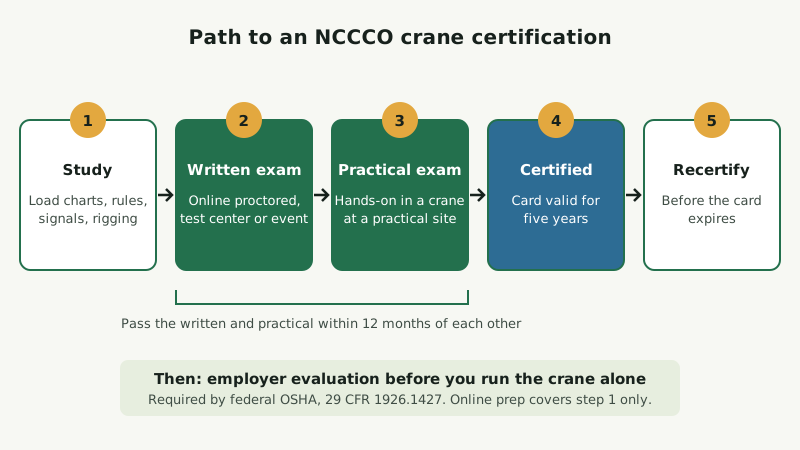
NCCCO certification takes two kinds of testing. The written side for mobile cranes is a core exam plus at least one specialty exam tied to the crane type, and you can sit it through Online Proctored Testing from a private room, at a test center, or at a scheduled testing event. The practical is a hands-on test in a real crane at an accredited practical test site, run by an examiner.
You have 12 months from the first exam you pass to pass its matching counterpart, so it pays to line up both before you start. The order is up to you; plenty of candidates take the written first because it is easier to schedule. Our written exam guide and practical exam guide break down each one.
Step 5: Get evaluated by the employer who puts you to work
A certification card is portable; the employer's evaluation is not. Under 1926.1427, the company that hires you must train you on the equipment you will actually operate, assess your skill and judgment, and keep a record of that evaluation. The evaluator does not need to hold a crane card, but must have the knowledge and experience to judge the work. Change employers, or move to a very different machine, and expect to be evaluated again.
Arkansas adds nothing at the state level on top of this. There is no state crane license, and federal OSHA enforces the rule on private jobs. See certification vs. license for how this compares with places that do license operators.
Do you need a CDL?
Crane certification and a commercial driver's license are separate things, and NCCCO does not require a CDL. Whether you need one depends on driving the machine on public roads. Under FMCSA's classes, a single vehicle with a gross vehicle weight rating of 26,001 pounds or more calls for a Class B CDL, and a combination of 26,001 pounds or more pulling a towed unit rated over 10,000 pounds calls for Class A. Many truck cranes and larger boom trucks fall over that line, so employers running them commonly want operators who can drive them between jobs.
Rough-terrain and crawler cranes are hauled on trailers rather than driven down the highway, so the CDL question there belongs to whoever drives the truck. Check the rating plate and ask before you assume either way.
When you know which card you're after, the enrollment form is the quickest way to ask which course fits.
Questions people ask
How long does it take to become a crane operator in Arkansas?
It varies widely. Union apprenticeships run for years, while someone already running equipment for a contractor may test within months. The deciding factor is supervised seat time, not the paperwork.
Can I get certified without any experience?
Check the current candidate handbook for your crane type, but the bigger obstacle is the practical exam itself, which assumes you can already run the machine smoothly against the clock. Without real hours at the controls it is a hard test to pass, and employers will still evaluate you before letting you work alone.
Is a heavy-equipment certificate the same as a crane card?
No. NCCER-based heavy-equipment programs teach dozers, excavators and similar machines. Crane certification is a separate credential from an accredited crane certifying body.
What is the cheapest first step?
Get hired on a crew that runs cranes and start learning the knowledge side early. Rigging and signaling cards are often the first credentials a newcomer earns.
Related courses
-
Mobile Crane Operator
Self-paced study for the NCCCO mobile crane Core and your LAT, TLL or TSS specialty, aimed at Arkansas operators on hydros, all-terrains and crawlers.
-
Service Truck Crane Operator
Written exam prep for the restricted NCCCO Service Truck Crane credential, aimed at Arkansas mechanics who lift components with the crane on their service body.
-
Rigger Level I
Self-paced study for the NCCCO Rigger Level I written test, covering slings, hitches, hardware checks and signals for crew members who rig everyday picks with a known load weight.
-
Signalperson
Study for the NCCCO Signalperson written test on any device, covering standard hand signals, voice and radio communication, crane behavior and the federal OSHA rules for directing a lift.
Start your Arkansas crane certification prep
Name the card you need (operator, rigger or signal person) and the part of Arkansas you work in. An enrollment advisor writes back with the matching course and what the exam steps look like from there.
- Self-paced lessons that open on any device, day or night
- Practice questions written in the style of NCCCO written tests
- Crew enrollment for Arkansas contractors and plants
Ask about enrollment
Short form. Your details are used only to reply to you.